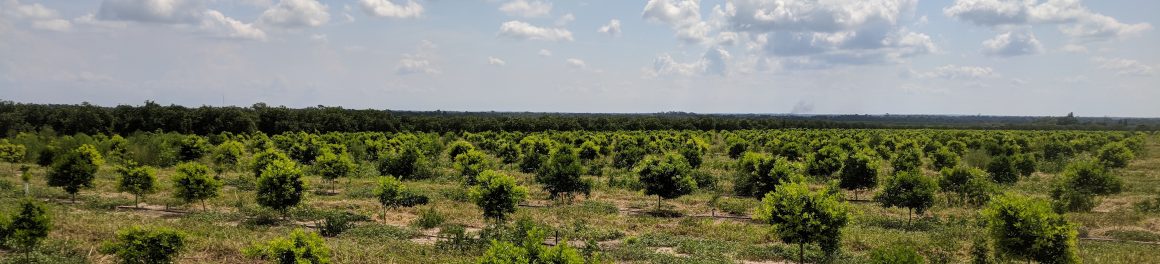
What do citrus trees look like after 2 years of coverage with white and red-dyed kaolin? See for yourself!
Next week week have a presentation of actual data of results with growth, insect populations, and HLB infection status.
What do citrus trees look like after 2 years of coverage with white and red-dyed kaolin? See for yourself!
Next week week have a presentation of actual data of results with growth, insect populations, and HLB infection status.
There has been discussion lately about how effective are antibiotics in citrus groves. In order for these to take down Las, the bacterium that causes greening, they need to be moved in the vascular system, particularly the phloem, where Las hangs out. So, are leaf-sprayed antibiotics moved systemically?
This is the question some colleagues and I asked in a recent paper. We were following up on some of Nian Wang’s research that showed how trunk-injected oxy-tetracycline (which we’ll affectionately call “oxytet”) moved around the citrus plant, eventually reaching all parts. We had a few questions:
In the same study we looked at some of the effects of heat treatment, but today we’ll just look at oxytet delivery. These trees did not have HLB, this is because we wanted to look at oxytet movement, not efficacy against Las.
Some plants we removed all new flush, some we removed all old flush, and some we left all the leaves. We covered about 1/4 of the canopy of small trees with impermeable plastic. Then we sprayed the rest of the canopy. After the spray had dried, we removed the plastic. About 3 weeks later we sampled both the leaves that were directly sprayed and those that weren’t. Then we tested each for oxytetracycline content.
We still don’t know whether the concentrations that made it do the unsprayed leaves were enough to reduce the Las levels, because we actually don’t know how much oxytet it takes to bring Las down in the plant. This study didn’t address streptomycin, the other antibiotic that is labeled to use against Las, so we don’t know whether it would move similarly.
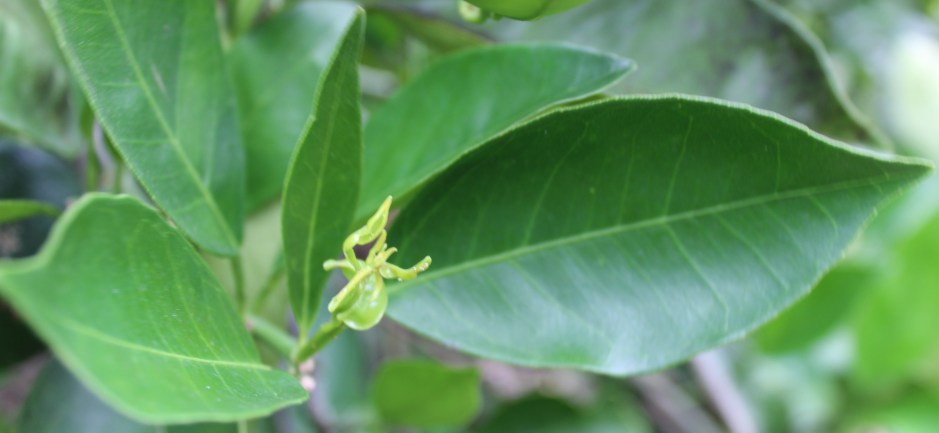
Because the life cycles of two important pests, Asian citrus psyllid and citrus leaf miner, are closely linked to the emergence of new flush. Growers could benefit from spraying only when there is new flush. But if the late flush is spread out over a month or even more, then what’s a body to do?
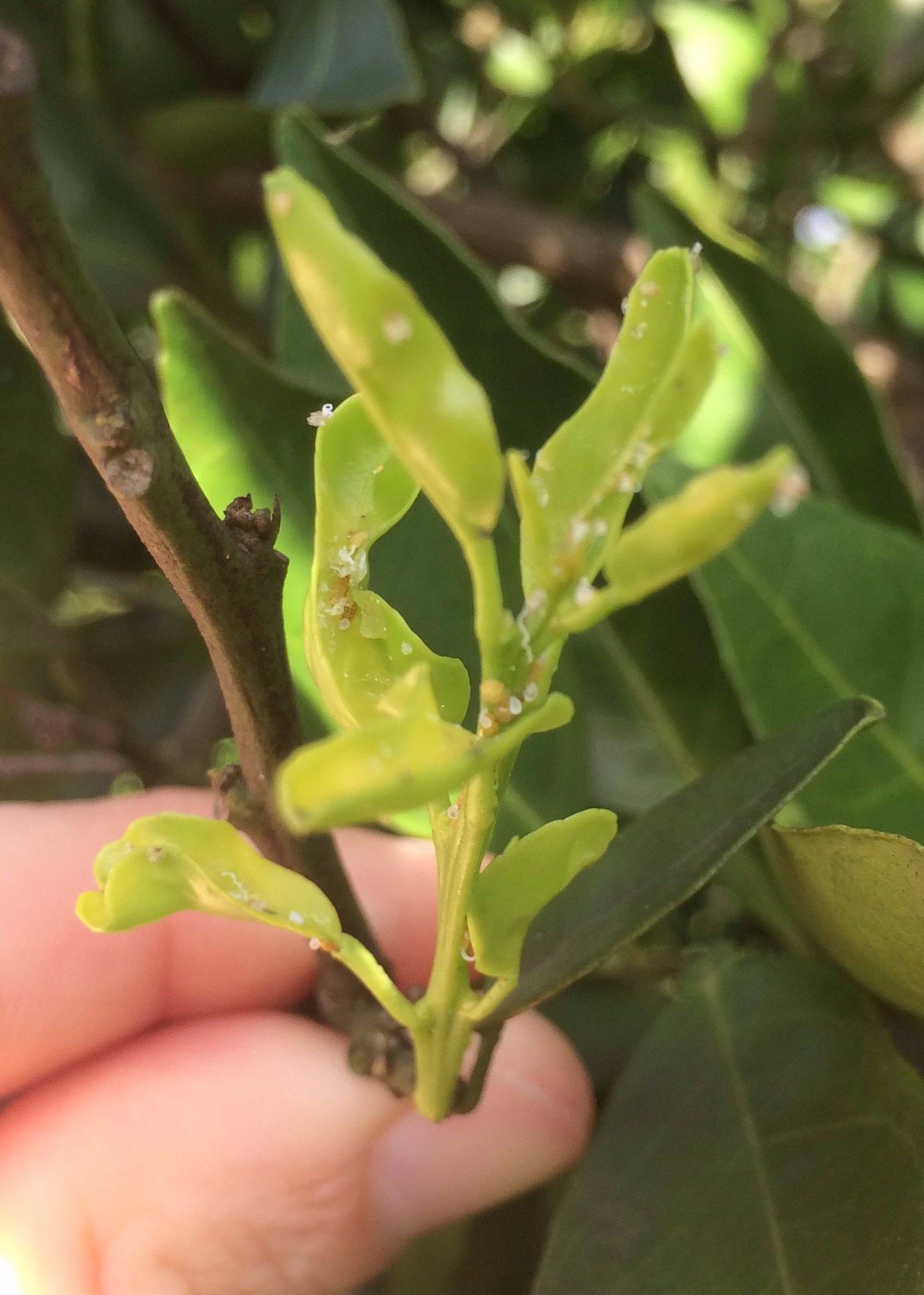
There may be ways we can manipulate the timing of flush directly. But to do that we need to understand how the plant regulates its own growth patterns.
Citrus trees have a different growth cycle than most common fruits. Like many fruits, they flower in the spring and then fruit develops over the next several months. Deciduous plants add vegetative growth (leaves and shoots) during a solid, extended period of the year. Citrus plants grow in several cycles of vegetative flushes over the year. The number and the size of these flushes depends on the environment. In Florida there are 2-3 vegetative flushes per year. Usually this begins with a flush in May, with later flushes in July and September or October. These flushes become less coordinated from plant to plant in a grove as the year waxes on, with May flush being relatively concentrated and the late flush being very sporadic.
The plant has to balance the needs of the leaves for water and nutrients with the needs of fruits and roots for sugars. This gets even more complicated when the plant has to send sugars to a new shoot to new flushes that will need to grow more than 1 cm in a day. So the plant needs to to start flushing at just the right time so that its fruits and roots don’t starve. It also needs to not start a new flush when the old one is not yet mature. What researchers in the 1990s observed is that root growth stops when shoots are growing.
We humans have the benefit of brains that coordinate all the different ends of our body, so that our heart beast the right amount for our feet to be able to run. Plants don’t have benefit of brains, so they rely on chemical signals. These signals can be molecules that move from roots to leaves or that accumulate in one part of the plant when the other part stops using that compound. Most of these signals are called phytohormones, because their effects are very large compared their very small concentrations. Growing shoots send out signals called auxins that keep other buds from growing so that there aren’t too many flushes. Meanwhile, gibberelic acid and cytokinins coordinate between roots and shoots. Not all of these dynamics have been completely explained in the case of citrus flush phenology, but we are gaining ground!
Knowing the “code” the roots, leaves, and shoots use to communicate, allows us to grab the microphone and give a few orders. Thus it may be possible to manage the flush timing, to decrease its sporadic nature and improve the efficacy of our pest management, ultimately getting healthier plants with greater yields.
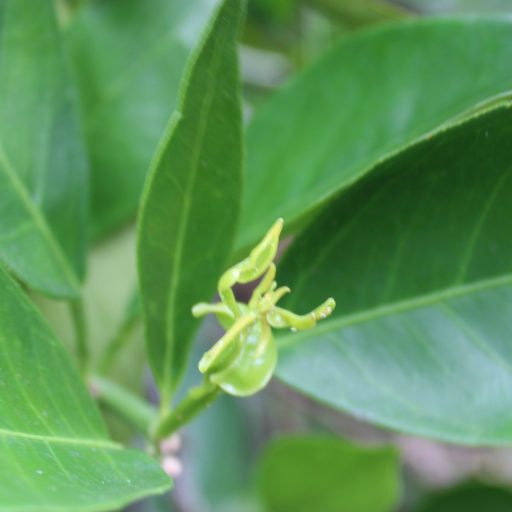
Because the Asian citrus psyllid stakes its reproduction on new citrus flush, there is a lot of interest in tailoring management to citrus phenology. “Phenology” is an uncommon word, but it boils down to how plant development changes over time. For instance the development of the spring flowering flush is a phenological process and names like “feather flush,” “popcorn,” and “full bloom” describe phenological stages.
Gene Albrigo has been involved in phenological modeling to predict flowering intensity and bloom time since well before the HLB era. He has recently turned to using this model to help improve psyllid management in two ways: reducing psyllid reproduction on new flush through pre-emptive psyllid management, and reducing negative impacts of insecticides on bee pollinations. In other words his goal is to kill adult psyllids before they can lay eggs on tender new flush but not hurt pollinator bees with applications late in the flush, when flowers have emerged. This can be done by using the models he and collaborators developed and have maintained for more than 10 years.
Gene has worked with several regional growers, selecting some blocks to manage psyllids based on phenological predictions, leaving others as controls with calendar or sampling-based sprays.

Gene recently reported results from the first two years of developing this approach. Results are positive, with reductions in adult psyllid numbers and egg-laying using the phenology-based approach, spraying once just prior to budbreak and again about 4 weeks later. This also allowed a bloom period that was free of insecticide applications, leaving the pollinators to range at the appropriate time. These results are promising for psyllid management during the floral flush, and I expect this approach to expand to become a standard practice.
 Citrus Tree Physiology Lab