Sugar movement in long leaf pines: accepting their limitations to keep moving

Plants face many hurdles to keep water moving up and sugars moving down, while keeping photosynthesis churning. Add to these challenges the fact that some plants may create their own limitations with constricted phloem. Recent work by a number of labs, in which we played a small part, shows that some trees may have restrictions in phloem movement.

Long leaf pines are rare in nature. Only a handful of conifer species worldwide have leaves longer than about 4″ (10 cm). Longleaf pines, though, native to the southeastern U.S. have needles up to about 1 foot (30 cm)! Why are long leaf species so rare, and why are our pine’s needles so long?
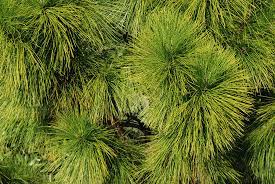
Longleaf pine (Pinus palustris) native to the Southeastern U.S.

The challenge of narrow pipes

It turns out that most conifers, including longleaf pine (Pinus palustris), have narrow sets of phloem tubes that all the sugars from photosynthesis along the whole length have to move into in order to make it out of the leaf. This means that the leaf closer to the base is loading into the same narrow “pipes” that the tip is loading. Imagine if you took a bunch of bottles, lined them up and connected them with only small holes between them so that the each bottle drained into the next. Then you poured a liquid – imagine, say, pink lemonade, because that’s more fun – into all the bottles at the same time. The end bottle would drain the slowest, while the base bottle would drain fastest. The result is that, without some adaptation, the base and the tip compete for loading and the tip may be unable to add enough sugar to make the phloem flow. This may help explain why most species don’t have long needles. But that begs the question, how do longleaf pines do it?
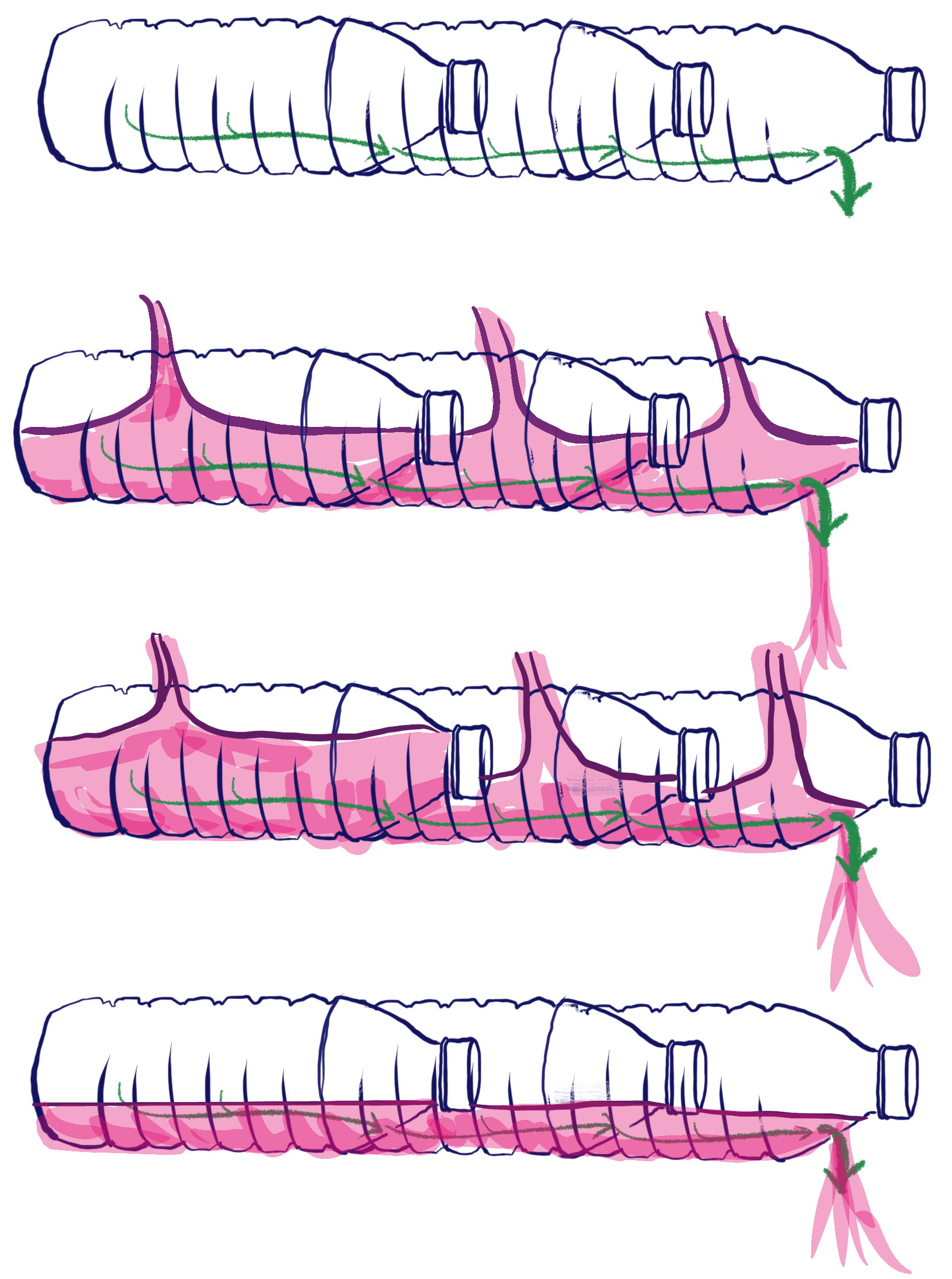
A “bottle model” of how export is limited in long needles.

Longleaf pines accept their limitations

Longleaf pines have anatomical adaptations that help reduce the loading limitation in their needles. They have specific files of phloem tubes that load mostly from certain leaf segments, which helps reduce the competitive effect, but not eliminate it. Because of this, they accumulate starch in their tips during the day, while the base regions run the sugar export show. But at night the tips rev up, and begin to export as the base begins to run out of reserves. In this way the various regions alternate in export over time, and keep export going.

Are long needles the only place where phloem constricts transport?

This is the clearest case of phloem transport limitation so far, but there may be other species that have similar challenges. Which we will discuss in the near future.

How much kaolin is too much?

Red and white kaolin on the class panes we use to measure transmittance.

One important question that growers have been asking is how much kaolin can be on a leaf before having negative consequences from too much shading. If you are considering applying another layer, and the original layer hasn’t been washed off, it is important to know how much kaolin can be on a leaf before it begins to have a negative effect. Because we have some idea of how individual leaves respond to different light levels.

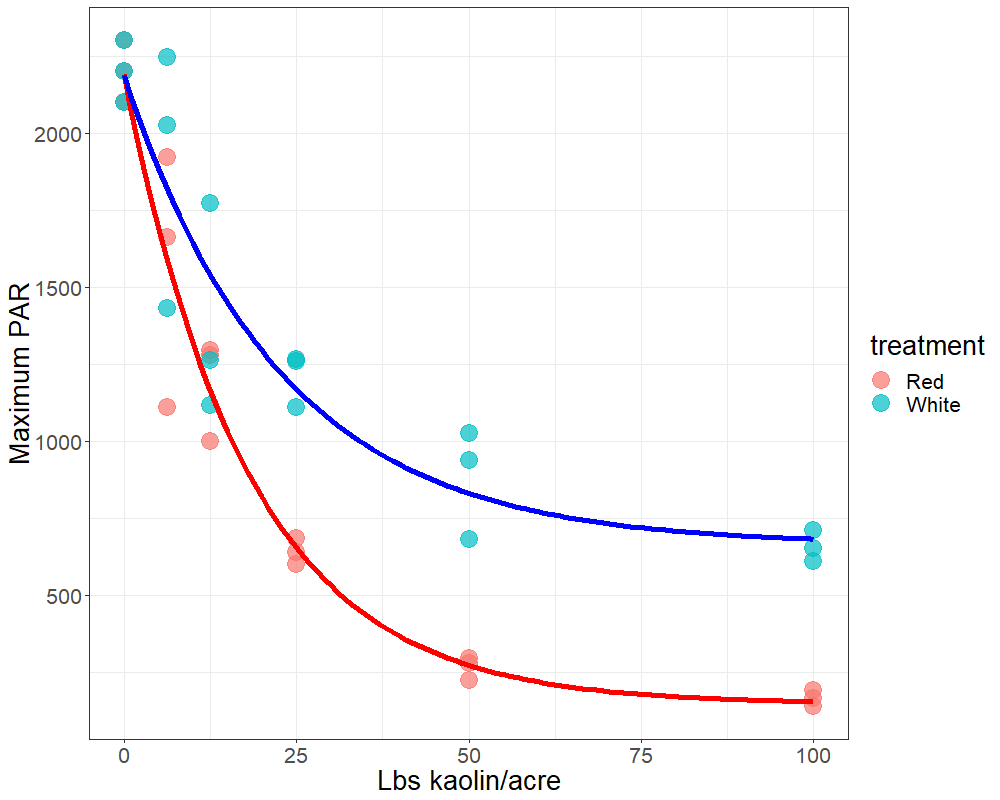
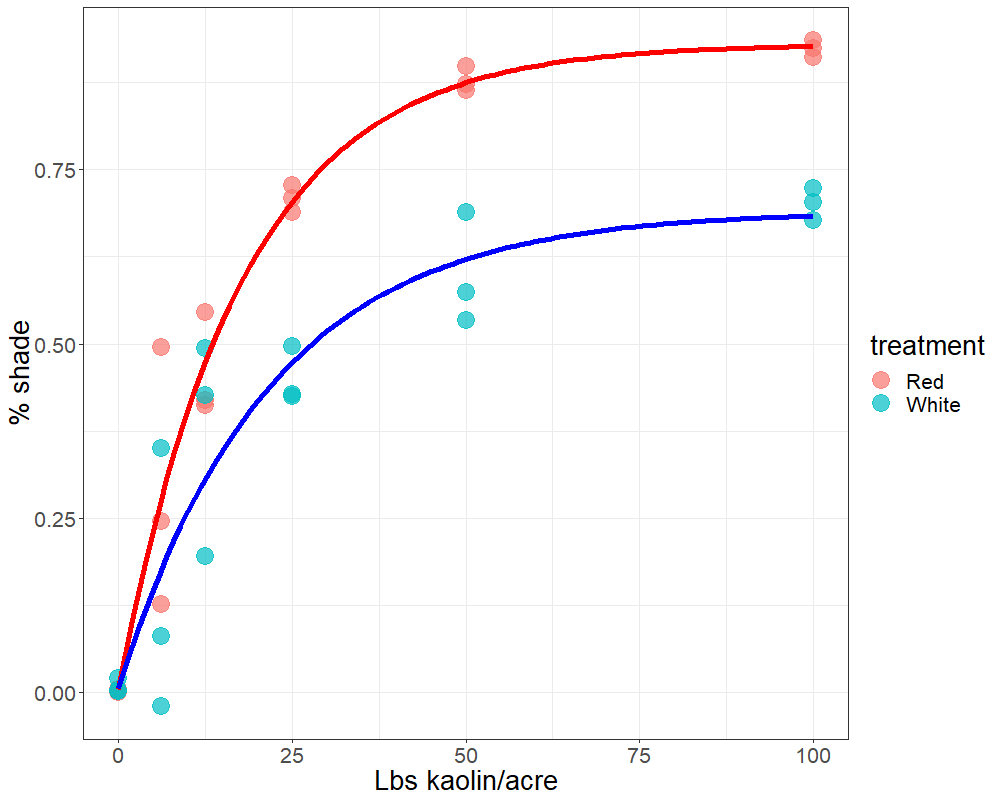
To answer this question we measured transmittance with the equivalent of different rates of kaolin. You can see the response plot below. One important feature of the response is that increasing rates of kaolin beyond 50 lbs/acre doesn’t increase the degree of shade to the same extent that rate increases below that level do.

So how much shade is beneficial for citrus plants? We can start by looking at the the maximum amount of light that these rates allow to reach the leaf.

Citrus leaves saturate at approximately 700 umols/m2 s, which means that additional light does not increase photosynthesis. With red kaolin, at the highest expected sunlight intensity (about 2200 umols), 25 lbs/acre reaches the level of shading reduces the light intensity of the exterior leaves to the saturation level, but the white kaolin doesn’t reach the level of 25 lbs/acre of red until 100 lbs/acre of white, though 50 lbs per acre reaches close to saturation.

Given these differences in intensity, we still don’t know why plants covered with the red seems to grow slightly more than those treated with the white. However, levels of red greater than 25-30 lbs/acre risk excessive diminishing light levels to exterior leaves, which means that they may not be able to maximize photosynthesis.

There can be a lot of complexity in terms of how much light reaches further into the canopy, which is part of how kaolin increases whole plant photosynthesis. However, it would seem that the risk of overapplicaton of white kaolin is low. You should be careful, though with repeated applications of red kaolin, unless previous applications have been mostly washed off.

Effects of kaolin on Asian citrus psyllid

Kaolin films are showing promising results in management of Asian citrus psyllid.  I recently presented preliminary results from our trial of Surround kaolin clay product and a Surround that we have modified with a red dye in presentations to the Polk County OJ Break and to the Citrus Research and Development Foundation research lunch.  To see the complete presentation click here.   

kaolin in field 6 mo
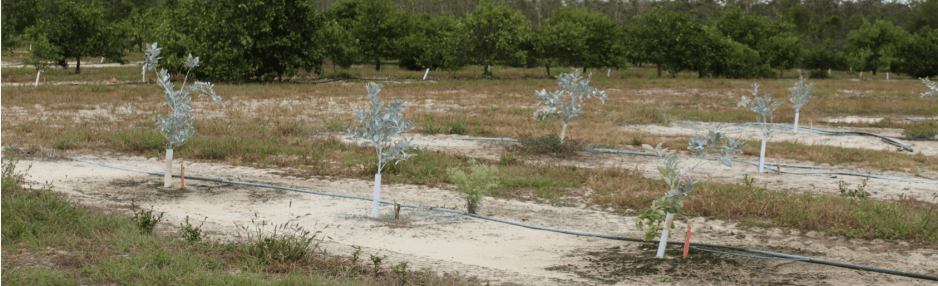
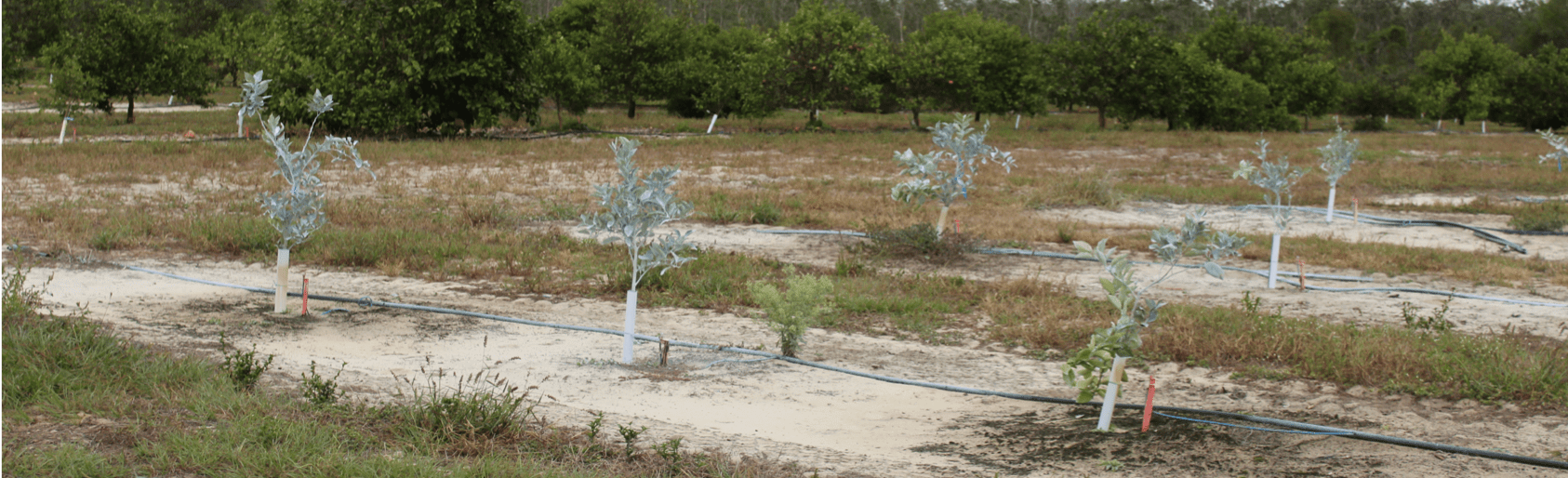
Six-month old trees with white kaolin.

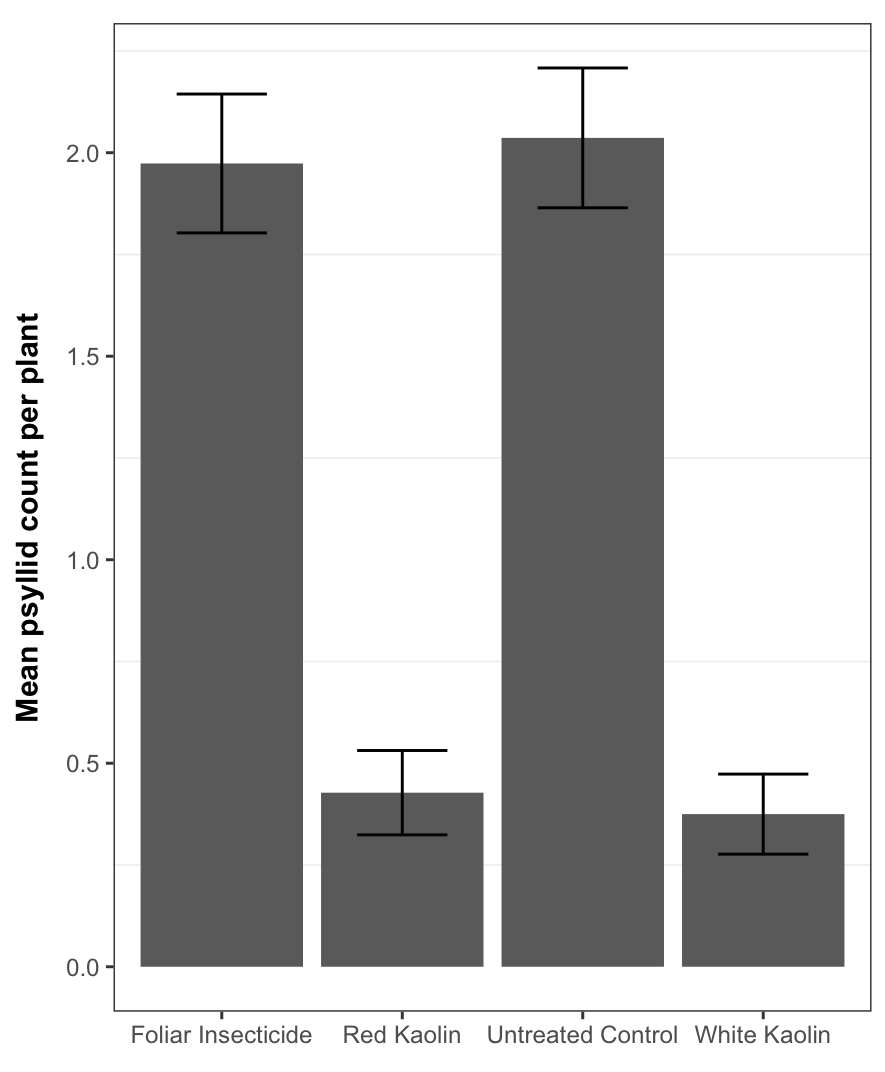
The results are promising: Over the course of the first year after planting we saw an 78% reduction in mean psyllid numbers per tree in the white kaolin treatment.  Thus far, this has also translated in lower infection rates, with a mean of 10% infection in the white kaolin versus 25% in the foliar insecticide treatment.  These results are early, so we should be cautious about jumping to conclusions.  However, other studies have produced similar results, and this means that growers should consider kaolin as a viable practice to incorporate into their management programs.

psyllid plot 1 year
Mean Asian citrus psyllid counts based on weekly counts over the first year after planting on trees treated with Red-dyed or non-dyed (White) kaolin or with foliar insecticide. Click here for full presentation.


Welcome Myrtho Pierre

2017-01-13-11-45-02

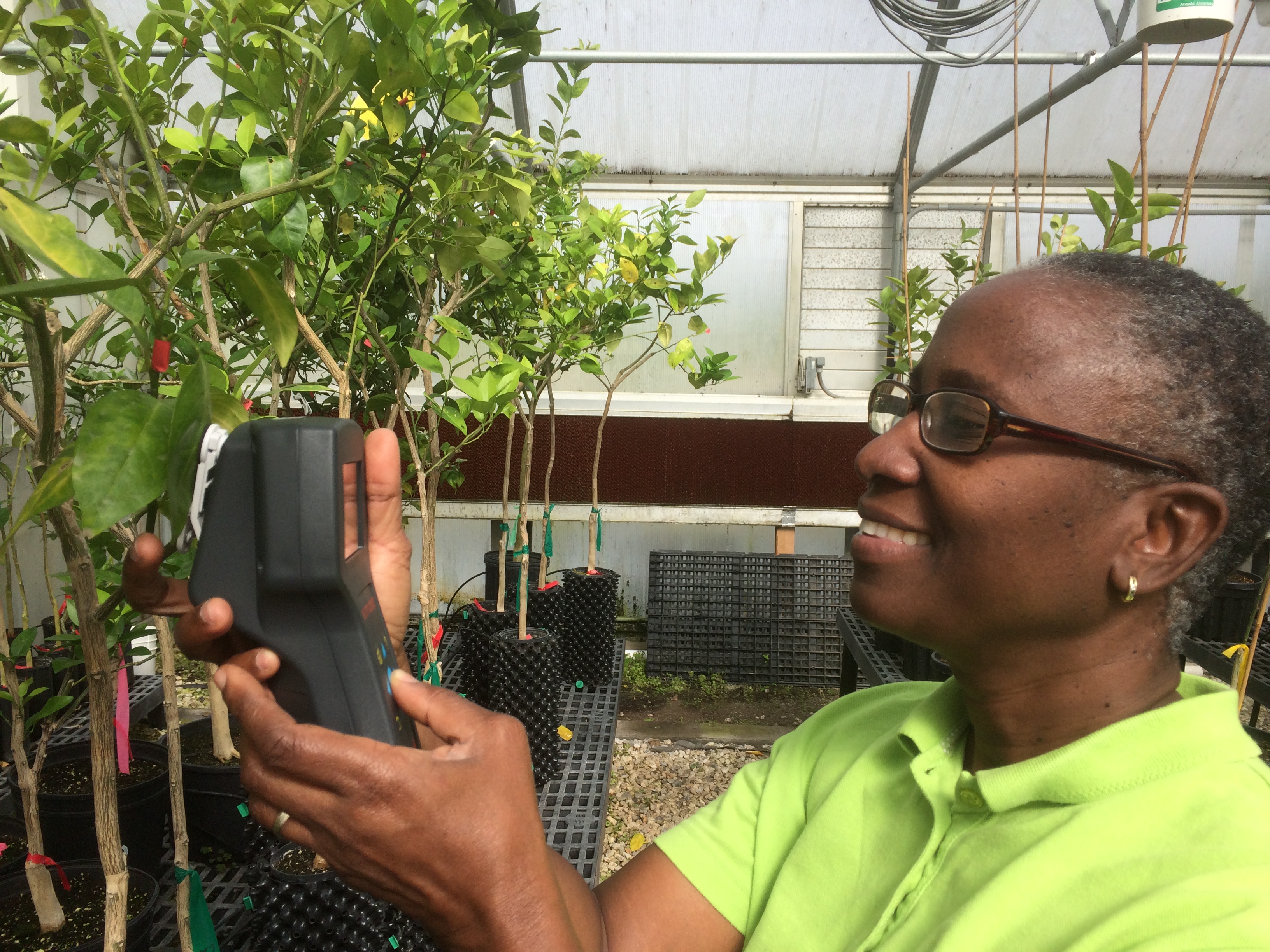
Myrtho Pierre is the new biological scientist in the lab.  She is already taking charge of many of our specialized measurements.  Myrtho worked for years in horticultural production and consulting in Haiti, and she has been working “behind the scenes” here at CREC for 4 years (3.5 years longer than I have!).  She brings organization and friendliness to the lab, and she is already knee deep in greenhouse management and calibration of chlorophyll fluorescence and root respiration measurement.  I look forward to good things to come.