Welcome back to the Hurricane Ian Recovery Project!
This project from the UF/IFAS Citrus Research and Education Center (CREC) is surveying citrus groves across the state to see how quickly the trees recover from Hurricane Ian. Our last blog post introduced the project and how we hope the results of the surveys will help growers better understand the medium-term impacts of hurricane damage on their groves to better protect them.
Hurricane Ian in 2022 caused significant damage to Florida citrus groves. Even groves that experienced only Category 1 winds have begun to decline as the weather has warmed. Trees in Florida citrus groves are exhibiting signs of canopy decline that include branch dieback and leaf drop. Branches with new growth are also experiencing leaf drop. These observations suggest that the trees are under significant stress. Our measures of photosynthetic efficiency also show declines in the health of the remaining leaves. Photosynthetic efficiency has decreased in trees from January to March of this year, indicating that the leaves are stressed.
Damage from Hurricane Ian is still affecting tree health. Field observations show that the hurricane caused mechanical damage to plant limbs, which could have impacted the vascular system. The vascular system is responsible for transporting water from the soil to the leaves. Leaves get a low water supply without proper water transport from the soil to the leaves.
Hurricane Ian’s damage is further leveraged by warming temperatures, which will increase in the coming months. High temperatures cause stress to the leaves. As the weather warms, the production of reactive oxygen species in the photosynthetic system can increase, which damages the photosynthetic machinery of the plant and decreases leaf health. High temperatures can also cause stomata closure, which reduces CO2 intake for photosynthesis. This leads to photoinhibition, which intensifies when the weather warms up.
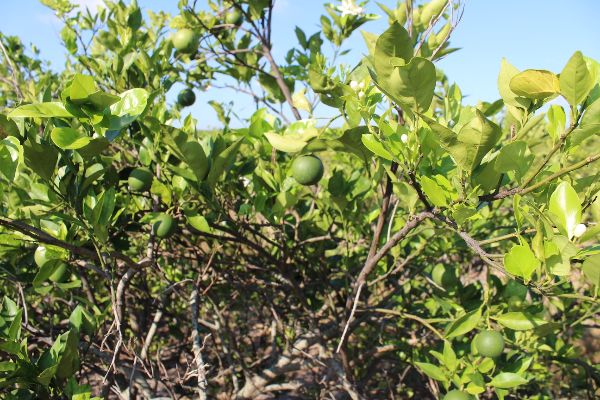
A sweet orange tree from western Polk Co. showing dieback very advanced fruit, and off-season bloom.
Low water supply also contributes to declining leaf health. When leaves have a low water supply and aren’t getting enough water, photosynthesis decreases and affects leaf health. The electron transport chain in photosynthesis requires a constant supply of electrons from water. When water availability is limited, the supply of electrons is also limited, leading to a decrease in leaf health. A low water supply can also cause a reduced transpiration rate. This increases leaf temperature, which also decreases leaf health.
Reducing stress is an integrated approach to enhancing leaf health. If trees can reduce their temperatures and get more water, they will have less stress and improved leaf health and growth. Maintaining appropriate soil moisture is one approach to reducing stress. One way to do this is more frequent irrigation. This would involve keeping irrigation volume the same but watering the tree in frequent small doses. This ensures sufficient water availability to plants. Another approach is to reduce leaf temperature and water loss. Kaolin particle films are one way to reduce leaf temperature. It reflects some of the sunlight, which helps cool the leaves and reduce photoinhibition by shading them. This allows leaves to utilize light energy efficiently, even when they have a low water supply. When leaves are not overheated, they can better use light energy for photosynthesis, and avoid stress. Kaolin clay can also help reduce water loss from leaves by shading and cooling them, reducing the temperature and light factors that reduce leaf health. Maintaining water can further improve the plant’s ability to photosynthesize and maintain good leaf health.
For questions or more information, please contact project leader Christopher Vincent at civince@ufl.edu.
 Citrus Tree Physiology Lab